
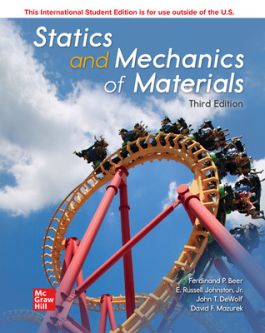
Statics and Mechanics of Materials ISE
3rd Edition
1260590208
·
9781260590203
© 2021 | Published: January 7, 2020
The approach of the Beer and Johnston series has been appreciated by hundreds of thousands of students over decades of engineering education. Maintaining the proven methodology and pedagogy of the Beer and Johnson series, Statics and Mechanics of Mat…
Read More
Request More Info
After you purchase your eBook, you will need to download VitalSource Bookshelf, a free app. Then login or create an account and enter the code from your order confirmation email to access your eBook.
- Access the eBook anytime, anywhere: online or offline
- Create notes, flashcards and make annotations while you study
- Full searchable content: quickly find the answers you are looking for
1) Introduction
2) Statics of Particles
3) Rigid Bodies: Equivalent Systems of Forces
4) Equilibrium of Rigid Bodies
5) Distributed Forces: Centroids and Centers of Gravity
6) Analysis of Structures
7) Distributed Forces: Moments of Inertia
8) Concept of Stress
9) Stress and Strain-Axial Loading
10) Torsion
11) Pure Bending
12) Analysis and Design of Beams for Bending
13) Shearing Stresses in Beams and Thin-Walled Members
14) Transformations of Stress
15) Deflection of Beams
16) Columns
Appendices
Index
Answers to Problems
The approach of the Beer and Johnston series has been appreciated by hundreds of thousands of students over decades of engineering education. Maintaining the proven methodology and pedagogy of the Beer and Johnson series, Statics and Mechanics of Materials combines the theory and application behind these two subjects into one cohesive text focusing on teaching students to analyze problems in a simple and logical manner and, then, to use fundamental and well-understood principles in the solution.
The addition of Case Studies based on real-world engineering problems provides students with an immediate application of the theory. A wealth of problems, Beer and Johnston's hallmark sample problems, and valuable review and summary sections at the end of each chapter, highlight the key pedagogy of the text.
The addition of Case Studies based on real-world engineering problems provides students with an immediate application of the theory. A wealth of problems, Beer and Johnston's hallmark sample problems, and valuable review and summary sections at the end of each chapter, highlight the key pedagogy of the text.