
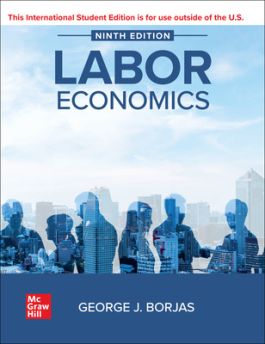
Labor Economics ISE
9th Edition
1266295852
·
9781266295850
© 2024 | Published: January 10, 2023
Labor Economics, ninth edition by George J. Borjas provides a modern introduction to labor economics, surveying the field with an emphasis on both theory and facts. Labor Economics is thoroughly integrated with the adaptive digital tools available i…
Read More
Request More Info
After you purchase your eBook, you will need to download VitalSource Bookshelf, a free app. Then login or create an account and enter the code from your order confirmation email to access your eBook.
- Access the eBook anytime, anywhere: online or offline
- Create notes, flashcards and make annotations while you study
- Full searchable content: quickly find the answers you are looking for
Chapter 1: Introduction
Chapter 2: Labor Supply
Chapter 3: Labor Demand
Chapter 4: Labor Market Equilibrium
Chapter 5: Compensating Wage Differentials
Chapter 6: Education
Chapter 7: The Wage Distribution
Chapter 8: Labor Mobility
Chapter 9: Labor Market Discrimination
Chapter 10: Labor Unions
Chapter 11: Incentive Pay
Chapter 12: Unemployment
Mathematical Appendix: Some Standard Models in Labor Economics
Labor Economics, ninth edition by George J. Borjas provides a modern introduction to labor economics, surveying the field with an emphasis on both theory and facts.
Labor Economics is thoroughly integrated with the adaptive digital tools available in McGraw-Hill’s Connect, proven to increase student engagement and success in the course.
All new Data Explorer questions using data simulation to help students grasp concepts
Materials are fresh and up to date by introducing and discussing the latest research studies where conceptual or empirical contributions have increased our understanding of the labor market.
The book has undergone Diversity, Equity, and Inclusion reviews to implement content around topics including generalizations and stereotypes, gender, abilities/disabilities, race/ethnicity, sexual orientation, diversity of names, and age.
Labor Economics is thoroughly integrated with the adaptive digital tools available in McGraw-Hill’s Connect, proven to increase student engagement and success in the course.
All new Data Explorer questions using data simulation to help students grasp concepts
Materials are fresh and up to date by introducing and discussing the latest research studies where conceptual or empirical contributions have increased our understanding of the labor market.
The book has undergone Diversity, Equity, and Inclusion reviews to implement content around topics including generalizations and stereotypes, gender, abilities/disabilities, race/ethnicity, sexual orientation, diversity of names, and age.